


Assuring the quality, quantity and emissions abatement of drop-in green fuels
Quantity assurance in marine biofuel supply chains
Completed
Project overview
Timeline
August 2026
GCMD team members
Dr Prapisala Thepsithar
Lead
Partners

Link copied to clipboard
Background of the study
If a buyer pays a premium for a B30 marine biofuel, how can they be certain they received the fuel they paid for?
That is the gap marine biofuel quantity assurance is intended to address.
Marine biofuel quantity assurance requires verifying two things: the total quantity of fuel transferred to the vessel, and the renewable fraction contained in that fuel.
The distinction matters because marine biofuels are purchased not only for their energy content. Buyers also pay for the renewable component and the associated reduction in life-cycle GHG emissions. That renewable quantity can underpin the green premium paid, GHG accounting and regulatory compliance.
Yet today, blend ratios such as B24 or B30 are typically declared by the supplier rather than independently verified. Drawing on evidence from GCMD’s end-to-end supply-chain trials, which involved the bunkering of more than 10,400 MT of biofuel blends, this report proposes a technically defensible and practical approach to quantity assurance. It combines custody-transfer measurement, independent laboratory analysis, and acceptance criteria that account for normal analytical uncertainty.
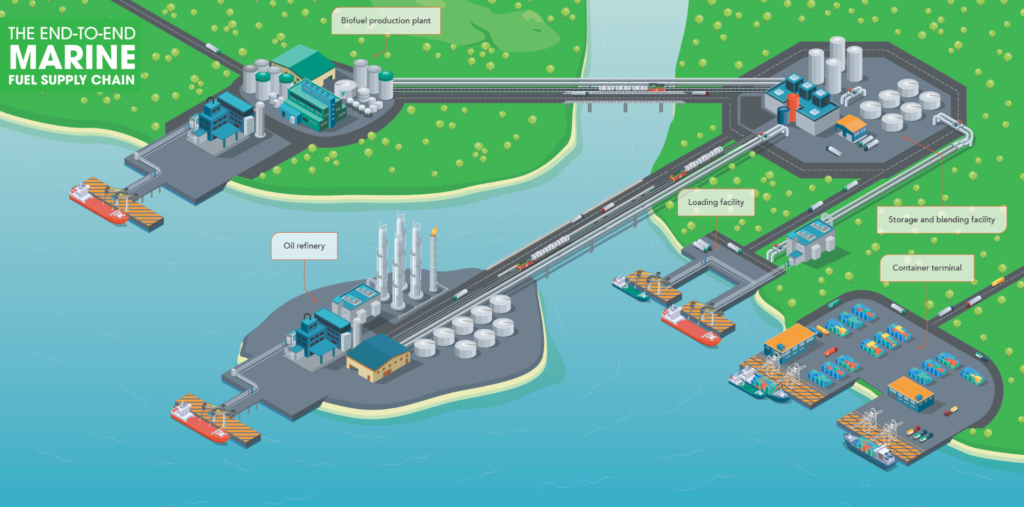
Understanding marine biofuel quantity assurance
Quantity assurance is the process of confirming both the total quantity of fuel delivered to a vessel and the amount of renewable fuel contained in that delivery.
Conventional bunker quantity assurance has primarily focused on total quantity transferred at the custody-transfer point. Marine biofuels introduce additional considerations because the renewable fraction carries a green premium; supports GHG accounting; may determine regulatory eligibility; and underpins sustainability and commercial claims.
Marine biofuel quantity verification has two separate components:
1. Verifying the total quantity of fuel transferred: At the custody-transfer point, quantity is determined using either static tank gauging or dynamic metering. Coriolis mass flow meters (MFMs) have become the preferred technology because they directly measure mass flow while providing a transparent and auditable basis for custody transfer.
2. Verifying the renewable fraction of the blend: This requires independent laboratory analysis because custody-transfer measurement alone cannot establish renewable content. The method depends on the biofuel. ASTM D7963 or ASTM D7371 can be used to quantify FAME content in FAME-based blends, while radiocarbon analysis in accordance with EN 16640 can determine the renewable carbon fraction in HVO.
A mass flow meter can determine how much fuel was transferred, but it cannot independently establish how much of that fuel is renewable. The renewable fraction must be tested separately.
Verifying the total fuel quantity
The total quantity is established at the custody-transfer point using tank gauging or dynamic metering. Coriolis mass flow meters are the preferred approach because they directly measure mass flow and provide an auditable transfer record.
A mass flow meter is reliable only when the final fuel blend remains within the meter’s validated operating range under the actual transfer conditions.
FAME generally has a much lower viscosity than residual marine fuels. As a result, blending FAME into fuels such as VLSFO or HSFO lowers the viscosity of the final blend. Where the base fuel already has a relatively low viscosity, or where a higher FAME blend ratio is used, the final blend may fall outside the mass flow meter’s (MFM) validated operating range.
Custody-transfer MFMs typically achieve measurement uncertainty of ±0.5% within their validated range, but this uncertainty can increase when viscosity falls outside that range. MFM suitability should therefore be assessed based on the viscosity of the final blend at the metering point under actual transfer conditions, rather than simply on the designation or the base fuel grade.
The recommended operational controls include measuring final blend viscosity before transfer, managing transfer temperature when necessary, selecting higher-viscosity blend components, or using MFMs validated over a broader viscosity range.
Because viscosity changes significantly with temperature, managing the transfer temperature can help keep the blend within the MFM’s validated operating range and maintain reliable custody-transfer measurement.
Verifying the renewable fraction
The renewable fraction can be independently verified by an accredited laboratory using a method suited to the biofuel chemistry. FAME-based and HVO-based fuels require different analytical methods.
FAME content in marine biofuel blends can be measured using recognised compositional analytical methods referenced in ISO 8217:2024, such as ASTM D7963 and ASTM D7371. These methods quantify the FAME present in the finished fuel and can be used to independently verify a supplier-declared blend ratio, such as B24 or B30.
HVO content cannot be reliably quantified using conventional compositional testing; it requires radiocarbon analysis.
Unlike FAME-based biofuels, HVO consists predominantly of paraffinic hydrocarbons that are chemically very similar to fossil-derived hydrocarbons in MGO. Once blended, there are no unique molecular fingerprints that can reliably distinguish renewable hydrocarbons from fossil hydrocarbons using conventional compositional analysis.
As such, differentiation instead relies on radiocarbon (14C) analysis, measured by an Accelerator mass spectrometry (AMS). This quantity is normalised to a modern carbon reference and expressed as per cent Modern Carbon (pMC). Fossil-derived hydrocarbons exhibit pMC values close to zero, whereas recently derived biomass exhibits pMC values close to 100. Measurements of 14C therefore provide a direct basis for quantifying the renewable carbon fraction in HVO-based blends.
Measured renewable content can differ from the declared blend ratio for two reasons: for FAME-based blends specifically, neat FAME itself is not 100% ester; and for both FAME- and HVO-based blends, every analytical method carries some measurement uncertainty.
For FAME-based blends, EN 14214 specifies a minimum FAME content of 96.5% m/m for neat FAME, meaning it can contain up to 3.5% non-ester material. A supplier-declared BXX blend is therefore not expected to contain an identical percentage of FAME in the finished fuel; it should contain a minimum FAME content equal to 96.5% m/m of the declared FAME blend ratio.
Laboratory methods — whether compositional analysis for FAME or radiocarbon analysis for HVO — also have finite measurement precision, reflected in their repeatability (variations between results obtained within the same laboratory) and reproducibility (variations between laboratories). A difference between a measured result and a declared blend ratio therefore does not necessarily indicate incorrect blending or under-delivery.
Interpreting verification results
Acceptance criteria should be technically justified and established before testing, accounting for the analytical method’s measurement uncertainty and the characteristics of the neat renewable component (e.g. FAME’s non-ester content).
Results falling outside this range should trigger further investigation.
GCMD’s assurance framework for marine biofuel supply chains
Marine biofuel supply chains raise two other distinct assurance questions:
- Quality assurance: Is the fuel safe, stable, and fit for marine use with existing engines onboard vessels?
- GHG emissions abatement assurance: Does the fuel genuinely deliver the claimed emissions reductions?
GCMD has previously addressed quality assurance and GHG emissions abatement assurance through a series of publications grounded in evidence from its end-to-end marine biofuel supply chain trials conducted under commercial operating conditions.
On quality assurance:
Project LOTUS: Long-term impact of continuous use of biofuels on vessel operations
Biofuel degradation study: Tracking the propensity of biofuels degradation across the maritime supply chain
On GHG emissions abatement assurance:
Get in Touch

