
Scaling adoption of energy efficiency technologies
Project FEET: Pilot fund for energy efficiency technologies
Objective
Develop and launch a first-of-a-kind pay-as-you-save fund for energy efficiency technologies (EETs)
Project scope
• Catalyse private capital from a pool of investors having different risk appetites
• Invest in a diverse set of EET retrofit projects
• Demonstrate viability of pay-as-you-save by pegging part of returns to quantified and verified fuel savings
• Showcase scalability of such a fund
Highlights
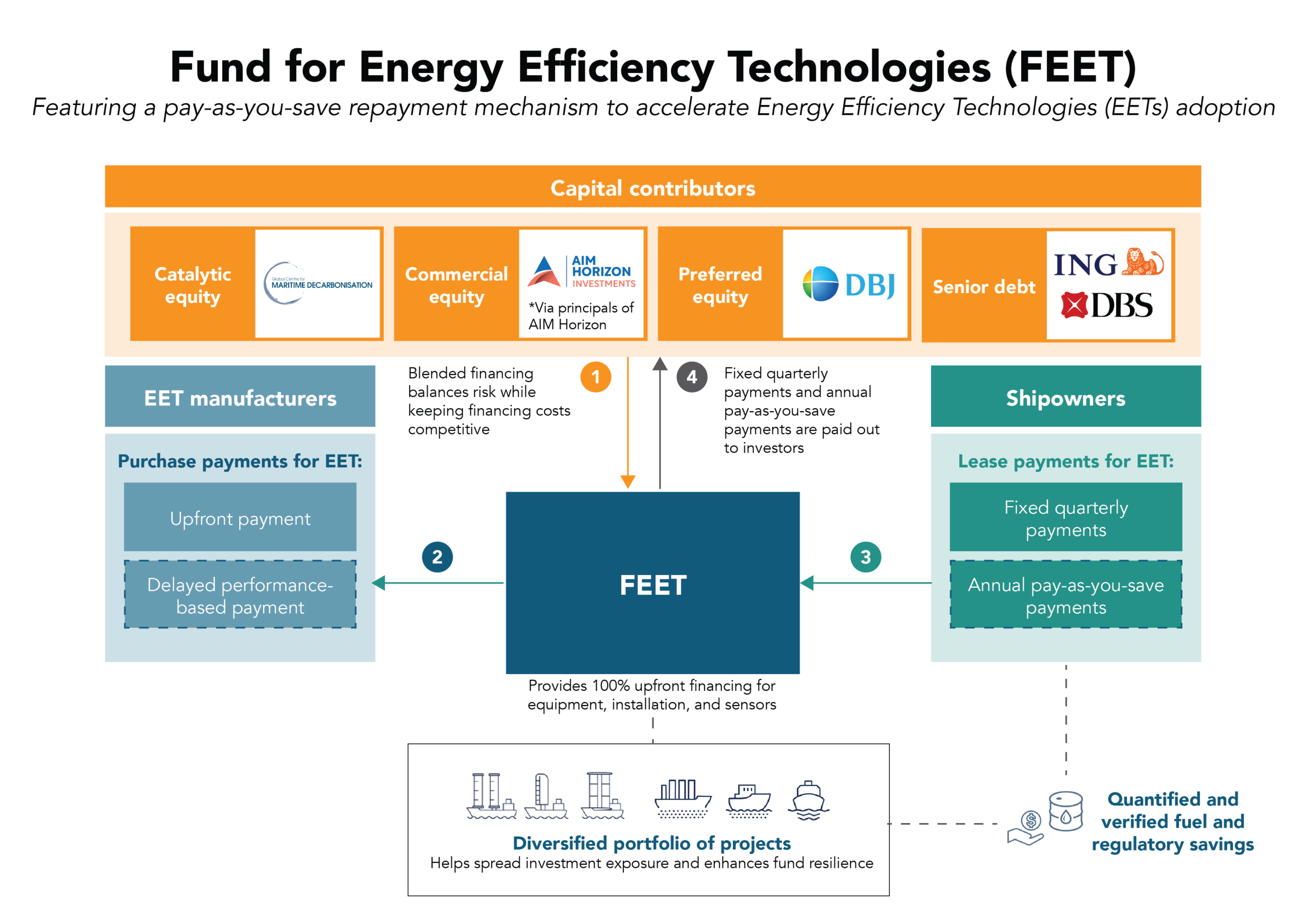
• Fund for Energy Efficiency Technologies (FEET) provides up to 100% upfront financing for retrofits and introduces a pay-as-you-save repayment mechanism linked directly to verified fuel and regulatory savings
• By offering unsecured leases on retrofits, FEET decouples retrofit financing from vessel mortgages
• Through a blended financing structure and a diversified project portfolio, FEET balances financial risk while keeping financing costs competitive
Press release: World’s first vessel retrofit fund using a pay-as-you-save repayment mechanism closes at USD 35M
The Fund for Energy Efficiency Technologies (FEET) is the world’s first vessel retrofit fund that utilizes a pay-as-you-save (PAYS) repayment mechanism to facilitate maritime decarbonisation.
It provides up to 100% upfront financing for the equipment, installation, and sensorisation costs associated with Energy Efficiency Technologies (EETs). Repayments to the fund are linked directly to quantified and verified fuel and regulatory savings, ensuring that the cost of the retrofit is covered by the operational gains it generates.
A key feature of the fund is its use of unsecured leases, which decouples the financing from primary vessel mortgages to overcome traditional lending barriers.
At the conclusion of the lease period, ownership of the technology is transferred to the shipowner for a nominal fee.
Pay-as-you-save (PAYS) is a performance-linked financing model where repayments are directly tied to quantified and verified fuel and regulatory savings.
Unlike traditional financing that relies on theoretical projections, the PAYS mechanism ensures that financial outcomes track actual operational performance.
Within the maritime sector, this model is used to overcome barriers to decarbonisation through several key features:
Aligned interests: It aligns the interests of shipowners, manufacturers, investors, and lenders by allowing them to share performance risks and rewards,.
Data-driven verification: The model relies on high-resolution operational data—collected via high-frequency sensors—to isolate and statistically verify the real-world fuel savings attributable to a specific technology,.
Shared savings: Under this structure, savings resulting from reduced fuel consumption and regional carbon pricing (such as the EU Emissions Trading System) can be shared among stakeholders to improve project economics.
Structured repayment: In the FEET structure, the model is implemented through a lease that includes fixed quarterly payments supplemented by annual pay-as-you-save payments pegged to verified savings.
By switching the focus of performance sharing to financiers and linking payments to real-world results, PAYS creates an investable structure for energy-efficiency retrofits that previously lacked suitable financing.
The Fund for Energy Efficiency Technologies (FEET) provides the following levels of financing:
100% Upfront Financing: The fund covers up to 100% of the upfront costs for vessel retrofits, specifically including the equipment, installation, and sensorisation.
Current fund size: As of its initial closing in November 2025, the fund has secured total commitments of up to USD 35 million.
Future scaling: There is a strategic target to scale the fund to USD 500 million by 2030, which would be capable of supporting approximately 200 ships.
This financing is provided through unsecured leases, which allows the funding for these upgrades to be decoupled from the vessel’s primary mortgage.
TBA
The split-incentive problem in shipping is a long-standing structural obstacle where shipowners are expected to shoulder the cost and uncertainty of vessel retrofits, while charterers are the ones who typically realise the resulting fuel savings.
Key factors that contribute to this problem include:
Financial Misalignment: Because shipowners pay for the technology but charterers benefit from reduced fuel costs, there is little direct financial motivation for owners to invest in energy efficiency upgrades.
Performance Uncertainty: Fuel savings are highly variable, changing with weather, routing, and operational conditions. Without a standardised way to isolate and verify how much a specific retrofit (like wind-assisted propulsion) contributes to these savings, neither party can reliably predict their return on investment.
Risk Imbalance: Shipowners historically take on the full performance risk. If a technology underperforms, the owner loses their investment, whereas if it overperforms, the charterer gains the extra fuel savings.
You can enquire about FEET by reaching out to us at projects@gcformd.org.
